END of BEMM129
WHAT I HAVE ACHIEVED
The learning method of this module is novel and unique. Unlike ordinary modules, which use traditional teaching methods in the lecture theatre, but through the interaction between online resources and colleagues to achieve a more in-depth and diverse understanding of the content.
During the learning process, I published two blogs. The first one combined my own experience to discuss the difference between traditional marketing and digital marketing, and the impact of AI technology on future marketing. The second blog analyzed the reasons for Taobao’s success through the perspective of business model and SMAC. Through my colleagues’ comments on the blogs, I have gained more perspective viewpoints and deepened my understanding of the topic.
# MY COMMENTS AND PARTICIPANTS ON ELE
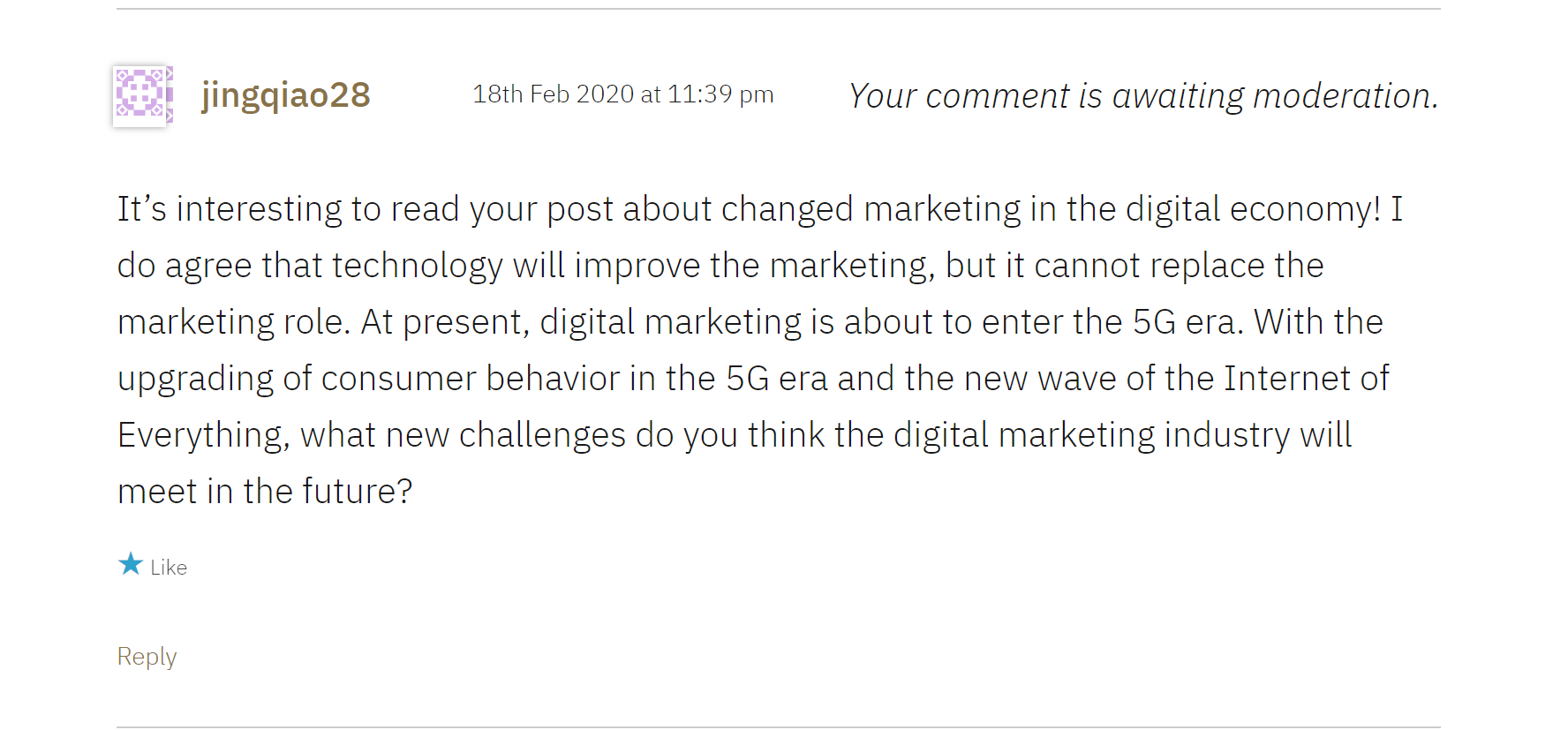
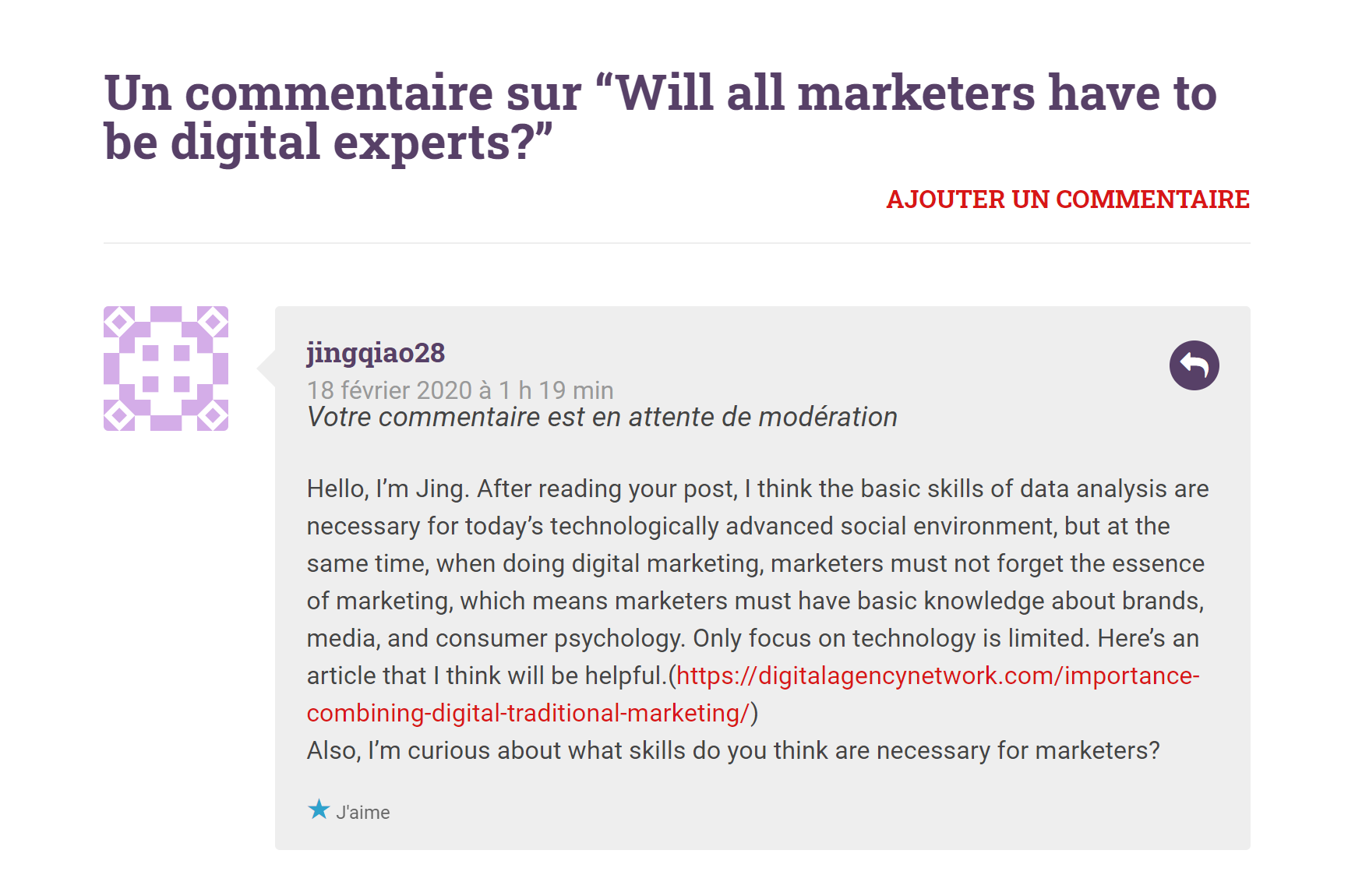
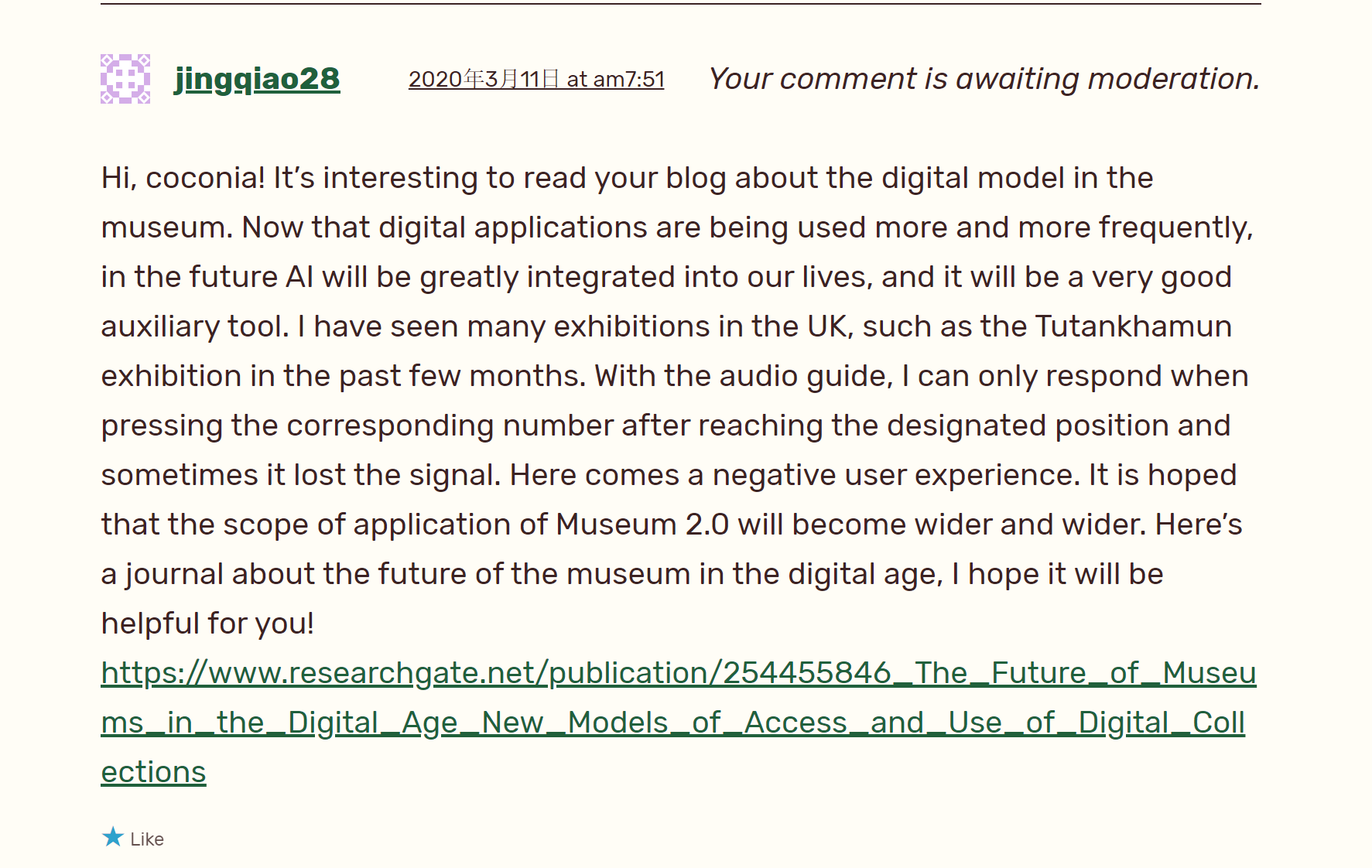

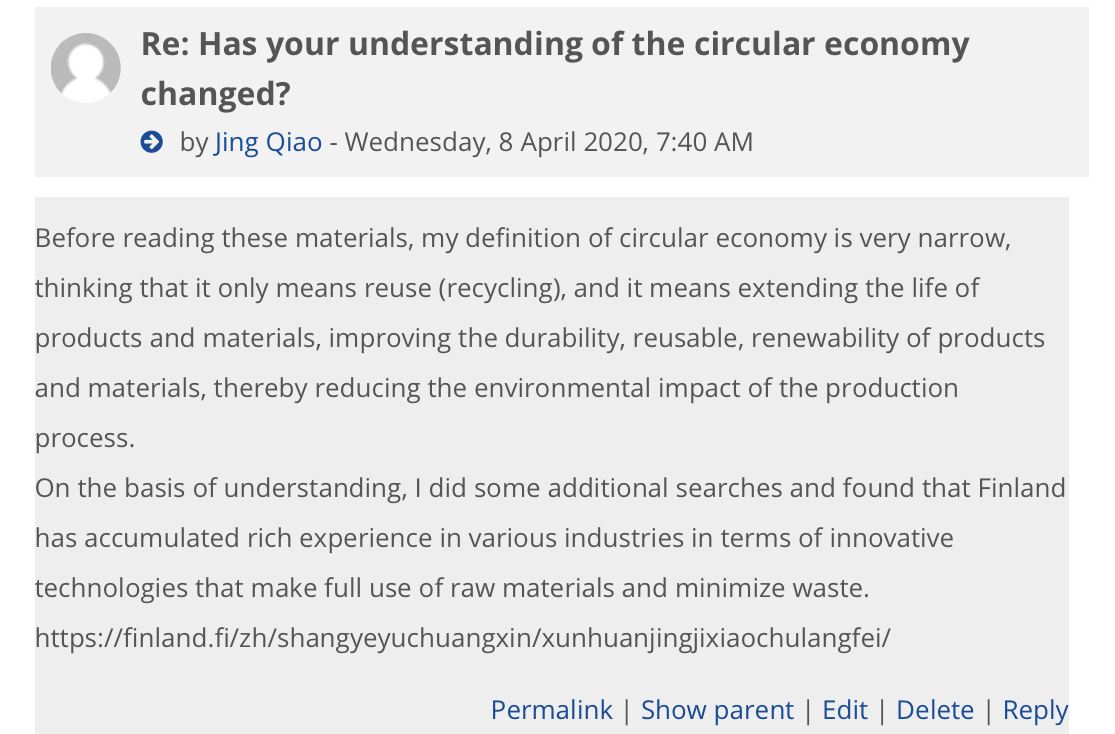

At the same time, I also actively participated in commenting on other people’s blogs and ELE. The first task about discuss the changed marketing in the digital economy, my blog content was slightly narrow. Debates about the impact of 5G on marketing from other colleagues’ blogs helped me improve my ability to think critically. This discussion and analysis made me better understand that each issue should be examined from both negative and positive aspects.
From the second task about the organisation in the digital economy, I realized that it is very important to grasp the concepts and technologies of the digital business model. Digital technology can not only be used directly by enterprises to increase productivity (Auditor), but also help to understand the art (Future plans to use AI to explain in the art museum).
Through participants in ELE, the materials provide me knowledge base for my blog, for instance, SMAC is the basis for an ecosystem that enables a business to transition from e-business to digital business. The four technologies improve business operations and help companies get closer to the customer with minimal overhead and maximum reach. It help me to analyse the reason for Taobao’s success.
- #TO CONCLUDE THE JOURNEY
FUTURE LEARNING – FORECAST
- KEEP RESCALING MYSELF ( continue MOOC learning ) – The module make me realize the digital business model plays a significant role in job career and need prepare for changing employment priorities in an increasingly digital and networked business world.
- PREPARE FOR DIGITAL TRANSFORMATION ( strengthen digital profile ) – It is undeniable that digital profile have become the first impression that many companies can obtain before a formal interview. The use of social media can be used as a marketing tool to improve the overall image of the individual and can maximize opportunities during the job search process.
- KEEP UPDATING MY BLOG…
#COMMENTS FROM BLOGS:
How Taobao be Succeed
Competent product of Alibaba
In the wake of technology and Internet development, many Chinese e-commerce business is benefited and they rapidly grow to be giant customers and achieve success. Alibaba, as the largest e-commerce business in China can be said to be the most successful e-commerce in the past 10 years and its found Jack Ma was ranked to be the Chinese wealthiest people in 2019 Forbs fortune 500 ranking. Its online business platform Taobao is the most competent product, its success is attributed to its effective and efficient digital business model. In this blog, I will elaborate how digital business mode of Taobao contribute to its success.
The Business Model
Taobao literally means “search for treasure” in Chinese and it is growing to be the largest online shopping website in China since its foundation in 2003. The business model of Taobao is business to customers and consumers to consumers. it places hundreds of millions’ products from business suppliers no matter they are big or small (Blystone, 2018). A biggest advantage of Taobao over the other online platform is that Taobao does not charge its business service fee, making it retain millions of business in Taobao.
Digital platforms can be categorized into digitalizing service, digital platform and crowdsourcing. Taobao is the digital platform and and it provides a market place to bring sellers and buyers of digital products. This business model is an innovative model for the market because traditionally people purchase goods from offline stores and they have to spend too much time. Taobao is creative to allows people to purchase goods online without going outside. Taobao takes advantage of Internet development it contributes to their success. The success secrete behind Taobao is that it focuses on small business and individual to sell their online products. Small business has large presence in China and they are inferior when competing with big companies because they do not have brand effects and they have little presence in distribution and shopping model.
SMAC
According to Heilig (2017), the modern digital transformation in online business is summarized by SMAC including social, mobile, analytics and cloud. Taobao is doing a great job in these areas to achieve advantages. In 2019, Taobao announced that it would establish a social online platform called “Tao Xiao Pu”, which is founded on the base of market trend and merchant feedbacks. Tao Xiaopu is a platform targeting the social business market. It is an innovative business model called “S2B2C”, and this platform is to serve customers by offering them with data driven service. Under this platform, customers will close to their customers. Taobao also offers them real time customer feedback and customization analysis.
Besides social, Taobao is a cloud computation base platform. Taobao takes use of the cloud service provided by Alibaba. Alibaba clouding is the world leading clouding and based on clouding, Taobao can have advantages in fast data process and customer analysis. For example, Taobao created the double 11 festival, in which day customers can purchased discount goods. In 2019 double 11 festival, Taobao achieved more than 25 billion RMB sales in single night. Clouding service supports its efficient customers information process (Emma, 2020). Meanwhile Taobao uses big data technique to analyze its customers, understanding their needs. Then Taobao can optimize its supply chain. Taobao is a big database and it uses big data technology and clouding to analyze data and understand customers.
source from https://www.youtube.com/watch?v=XWt_7rr2_hk
The Digital Model
The digital model of Taobao is supported by its advanced software and algorithm. Taobao team is very famous and they know how to use algorithm to guide customers and understand their consumption behavior. For example, Taobao use “recommendation” technique to provide customers with the goods that they used to search for. This can increase customers satisfaction rate and help them quickly identify their desired goods, Taobao therefore increases its sales.
The success of Taobao is dispensable from its presence in mobile applications. Taobao used to a web-base platform for customers to purchases good while now it is developing into a mobile phone base application because customers are shifting to mobile applications. Mobile phone penetration rate in China reached 51.8%, meaning that over 700 million populations are using smartphone. 60% of populations in China under 30 are users of Taobao (Perkin, 2017).
Overall the effective digital business model contributes to success of Taobao. Taobao is an innovator in using digitalization, big data and clouding techniques to understand its customers and deliver them with good service. Taobao focuses on small business and allows them to compete with big companies, gaining their favor and support. Meanwhile Taobao starts to shift its business to socialization, increasing more customers base.
Reference List
Blystone, D. (2018). Understanding the Alibaba business model, Investopedia, retrieve from https://www.investopedia.com/articles/investing/062315/understanding-alibabas-business-model.asp
Emma, L. (2020). Brief: Taobao Testing social e-commerce platform, Tech-node, retrieve from https://technode.com/2019/04/29/briefing-taobao-testing-social-e-commerce-platform-taoxiaopu/
Ebrun, (2020), Briefing: Taobao testing social e-commerce platform, retrieve from https://technode.com/2019/04/29/briefing-taobao-testing-social-e-commerce-platform-taoxiaopu/
Heilig, L., Schwarze, S., & Voß, S. (2017). An analysis of digital transformation in the history and future of modern ports.
Perkin, N., & Abraham, P. (2017). Building the agile business through digital transformation. Kogan Page Publishers.
Why People Spent $25 Billion On A Fake Holiday Called ‘Singles’ Day’. (2020). Retrieved 5 March 2020, from https://www.youtube.com/watch?v=XWt_7rr2_hk
Marketing changed in the Digital Economy
Before reading this blog, please review your recent purchases and think about the reasons that have contributed to your recent purchases, as well as the methods used. I believe that advertising on the Internet or from third parties (such as celebrities, bloggers, etc.) has a major influence. Personally, I recently purchased the latest Nintendo Switch Game-Ring Fit Adventure. Initially, whilst I considered buying the product, I had made a decision not to. However, online ads continued to be displayed on many websites, such as ads before playing videos and related pushes that appear when searching for fitness products. These adverts finally enticed me to buy.
In recent years, emerging industries within the digital economy have flourished. The digital economy has become an important driving force for the improvement and development of economic efficiency and optimization of the economic structure. It is also the primary area for the cultivation of new growth points, engendering the forming of new kinetic energy. Following on from the agricultural economy and industrial economy, societies are on the threshold of another social and economic form. The digital economy is represented by the Internet and big data, which has been deeply integrated into the economic and social fields of various countries. Marketing is one of the industries that have been completely changed by digitalization over the past decade.

Source: https://www.cio.co.ke/how-the-traditional-marketing-mix-can-assist-in-your-digital-marketing-efforts/
Traditional marketing has fundamentally focussed on promotional advertisement of companies and their products, to market their products. The strategy adopted has been the 4P combination proposed by Professor McCarthy; namely products, prices, channels and promotions (Doyle, 2011). Marketing channels include print advertising, billboards, leaflets, television, newspapers and radio etc. Traditional marketing is advantageous because it can easily reach the target local audience. For example, radio ads remain fixed to the same channel for broadcasting; promotional materials can also be easily retained because the advertising materials are paper copies and can be read repeatedly. Traditional marketing service business owners, and so the disadvantages is that there is almost no direct interaction between the media used and the prospective customers. Brands provide information in a more one-way system to the public and the costs of printing and staffing can be very high.
Digital marketing adopts and applies online marketing strategies such as social media to promote and sell products and services. This is advantageous because the data foundation is very strong; for example, the number of social media users in 2019 is shown in the figure (“100+ must-see digital marketing research statistics for 2019 | Smart Insights”, 2020). In addition, digital marketing is cost-effective; although some people invest in paid online advertising, it still costs less than traditional marketing. Also, data and results in digital marketing are easy to record, and the relationship between digital marketing and customers is in fact two-way.

Marketing innovation is a change from marketing thinking to operational thinking. The objective is to return to the essence of the business and consider how to operate with consumers and Internet users. The field of intelligent marketing may have entailed being to open multiple branches and expand customer service teams to improve customer service quality. Now, everyone uses artificial intelligence to continuously interact with customers, solve problems around the clock and use enough data at the same time to train AI customer services; data has become a new frontier. Described by a concept called ‘growth hacker’, this refers to a growth method that can attract millions of users in a short period at a very low cost through innovative methods and scientific data analysis tools (‘Growth Hacker’, 2020). However, the essence of marketing is to perceive demand through human nature. Since its development, customers have been the object of mining rigid and false demand in order to generate sales and profits.
Source: https://youtu.be/555amSBVFI0
Over time, digital marketing has gradually expanded from portal website display advertising and search marketing to social marketing, video marketing, content marketing and other forms, continuously incorporating new technical elements. Indeed, digital marketing has reconstructed the entire marketing ecosystem. Digital marketing goes from top to bottom, brand-centric and competition-oriented to be completely ‘consumer-centric’. Consumer groups are constantly being subdivided and personalized, and traditional demographic and sociological characteristics have been unable to define today’s consumers. With the escalation of consumer behaviour in the 5G era and the new wave of Internet of Everything, the digital marketing industry will need to further adapt in the near future to meet new situations and challenges.
Currently, digital marketing has now entered the 5G era. 5G will help brand-build for the customer-centric, comprehensive information ecosystem. There is also a capitalization of brand user data. In the context of the digital economy, data is becoming a ‘new wealth’ to help companies build data-centric strategic decision-making transformations. Also, digitally driven holographic tissue reconstruction can enhance the ability to respond quickly to the market; enterprises must build a flexible decision-making mechanism, as well as comprehensively reorganize from the product side, manufacturing side, operation side and marketing side, to ultimately realize the enterprise development tasks of growth as the goal.
Reference List
Doyle, C. (2011). A dictionary of marketing (3rd ed.). Oxford University Press.
Growth hacking. (2020). Retrieved 12 February 2020, from https://en.wikipedia.org/wiki/Growth_hacking
100+ must-see digital marketing research statistics for 2019 | Smart Insights. (2020). Retrieved 12 February 2020, from https://www.smartinsights.com/digital-marketing-strategy/100-must-see-marketing-stats/
How Digital Marketing Trend Change in the Future. (2020). Retrieved 13 February 2020, from https://youtu.be/555amSBVFI0
About Joyce
A short story 💌
Hi, my name is Jing Qiao. I am currently studying the MSc Accounting and Taxation programme. 💓
The story about me is brief. I was born in Jiangsu Province, China. Unlike common single children, I have a sister who is two years older than me. After living together for 19 years, I decided to study in the UK and she chose to stay in China. I have been in the UK for 4 years. I was studying at the University of East Anglia for the undergraduate courses – Intercultural Communication with Business Management. Now I’m studying for Master degree at Exeter University. I am very happy to participate in the Digital Business Model module, because the changing digital landscape brings me exciting experiences and challenges ! 😋
 Joyce Q